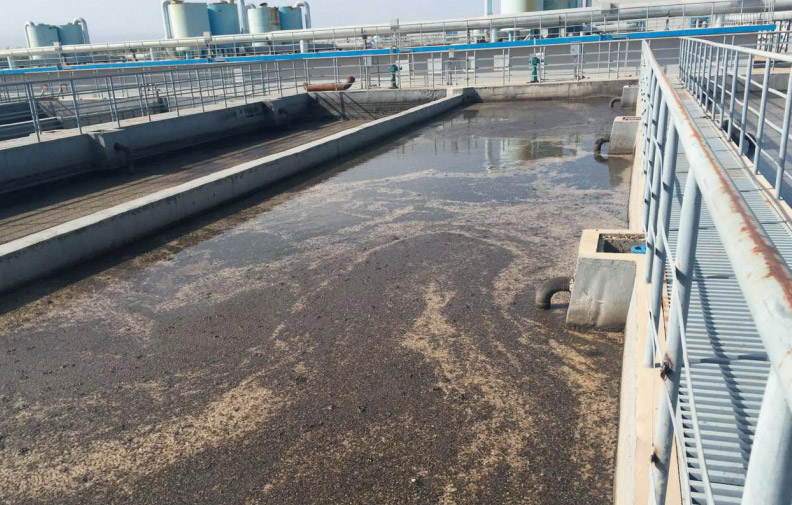
For wastewater or sewage from the petroleum, chemical, coal chemical, chlor-alkali chemical, printing and dyeing, power, steel, mining, and industrial park sectors, pre-treatment and advanced treatment processes are employed to ensure that the treated water meets the standards for greening, spraying, circulating water system makeup, production water, and boiler feedwater. This reclaimed water is reused in industrial, domestic, and water resource reserve projects.
● Wastewater Advanced Treatment and Reuse Project for the 600,000-Ton Methanol and Ammonia Project of Yanzhou Mining Xinjiang Coal Chemical Co., Ltd
● Industrial wastewater treatment and reuse project in Korla Economic and Technological Development Zone
● Wastewater treatment and reclaimed water reuse project in Shanshan Stone Industrial Park
● Wastewater treatment and reuse project in Xinjiang Shihezi Chemical New Material Industrial Park
● Printing and dyeing high-salt wastewater treatment, regeneration, and reuse project in Shihezi Industrial Park
● Domestic sewage treatment and reuse project for Korla Oil Transmission Station and Shanshan Oil Transmission Station of the Western Pipeline
● Wastewater treatment and reuse project in the industrial park of Mageti County, Kashgar Prefecture
● Green Community Reclaimed Water Treatment and Reuse Project of Xinjiang Huayuan Industrial (Group) Co., Ltd
● Urumqi Houxia Domestic Sewage Reuse Project
● Upgrading and Renovation Project of Sewage Plant in the North Area of Xinjiang Tiankang Animal Husbandry Biotechnology Co., Ltd
● 1000m3 sewage renovation project for Tiankang Biological Co., Ltd. (Tou District)
● Upgrading and reconstruction project of sewage treatment plant in Hejing County
The 600,000-ton alcohol and ammonia co-production project is the first coal chemical project initiated by Yanzhou Mining Group in Xinjiang. Based on the analysis of pollutants in the influent water quality, our company recommends a treatment process consisting of "clarifier + modified rapid filter + ultrafiltration + reverse osmosis". The treatment capacity of this project is 360m³/h, making it the first coal chemical wastewater treatment and reuse project in Xinjiang.
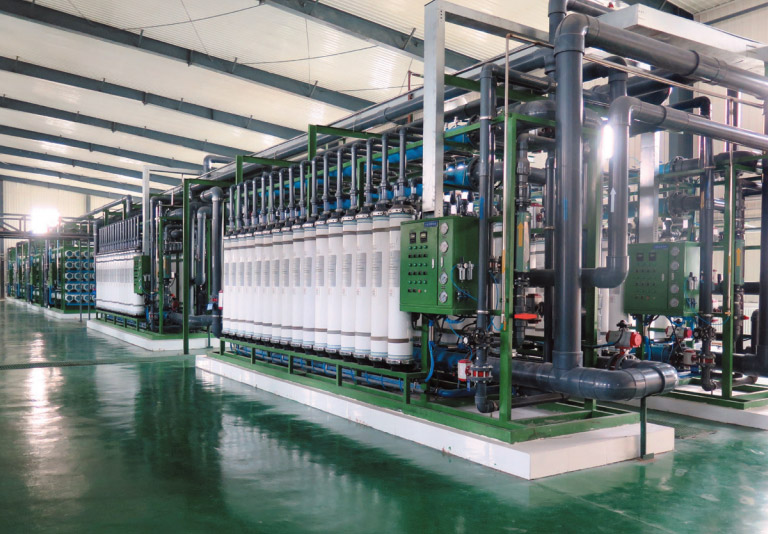
The Korla Economic and Technological Development Zone, upgraded to a national-level economic and technological development zone in 2011, is a new industrial park with a planned area of 140 square kilometers, featuring "specialized integration, concentrated investment, intensive resources, and clustered benefits" in new by-product processing and warehousing, petroleum equipment and manufacturing, high-tech, and biopharmaceutical industries. Currently, the park has attracted over 560 enterprises of various types, forming leading industries such as natural gas chemical industry and deep processing of cotton textile products. It is a strong industrial area in southern Xinjiang.
Our company has undertaken the first phase of the sewage treatment project for this industrial park, with a capacity of 50,000 m³/d. The effluent meets the Class A standard and is reused, addressing the water pollution issues brought about by the increasing number of enterprises in the industrial park and the robust economic development.
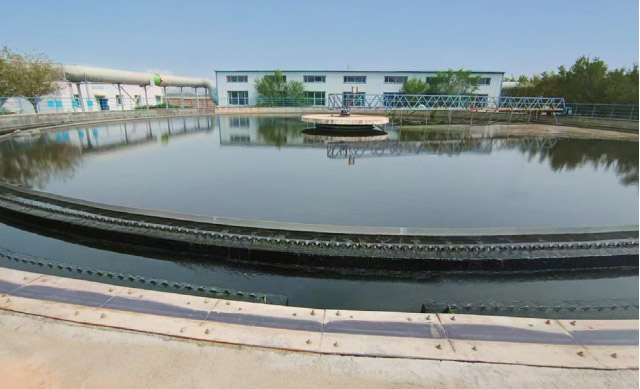
The wastewater treatment and reclaimed water reuse project in the Shanshan Stone Industrial Park is located in the northern area of the park, with upstream industries including polysilicon, stone, and non-ferrous metal smelting. The short-term capacity of the wastewater treatment plant is 5000m3/d, and the long-term capacity is 20000m3/d. The process adopted by the wastewater treatment plant is "coarse screen → fine screen → aeration grit chamber → distribution well → hydrolytic acidification → CAST → coagulation sedimentation → mechanical rotary disc filter → ozone catalytic oxidation → contact disinfection → clean water tank". The design inlet water quality meets the secondary standard of the "Wastewater Quality Standards for Discharge into Urban Sewers" (CJ343-2010), and the design outlet water quality meets the Class A standard of the "Emission Standards for Pollutants from Municipal Wastewater Treatment Plants" (GB18918-2002). A portion of the effluent is used for irrigation of ecological forests or discharged into ecological wetlands. Our company has undertaken the equipment procurement, installation, and commissioning of this project.
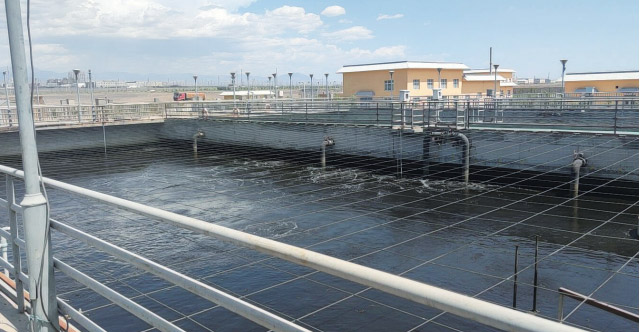
The Xinjiang Yihua Chemical Co., Ltd. has embarked on a new 30m³/h wastewater treatment project for synthetic ammonia. The treatment capacity stands at 30m³/h, broken down as follows: 15m³/h for HN compressed ammonia wastewater and 15m³/h for low-methanol residual liquid (low-temperature methanol washing wastewater). The scope of work encompasses the installation of buildings, structures (including auxiliary projects), process equipment, pipelines, water supply and drainage systems, electrical systems, instrumentation, and anti-corrosion and insulation measures within the designated boundary of the project. Additionally, it involves the construction of roads, pipe trenches, and cable ducts (all inclusive of auxiliary facilities) within the design boundary area. The procurement, unloading, storage, and installation of materials specified in the design drawings, as well as the no-load single-unit trial run and fault handling during the combined trial run, are also included in the scope of work.
The overall project adopts advanced and mature high-efficiency air flotation technology, UASB anaerobic reaction technology, and A/O technology. When the effluent quality of the secondary sedimentation tank fails to meet standards, the Fenton reaction technology is added to further meet the requirements for qualified effluent indicators. Specifically, the wastewater from H-N compressed ammonia distillation and low-methanol residual wastewater enter the regulating tank for mixing. The wastewater in the regulating tank is lifted by a lift pump into the air flotation equipment. Acid and alkali are added at the inlet of the air flotation tank for pH adjustment. PAC and PAM chemicals are added to the air flotation tank. The effluent after air flotation treatment is lifted by a pump into the UASB anaerobic reactor system, where most pollutants such as COD are removed. The effluent from the UASB reactor enters the AO biochemical system, where microorganisms degrade pollutants such as COD, BOD, and ammonia nitrogen. The effluent enters the secondary sedimentation tank, where mud and water are separated before entering subsequent units.


Copyright DeLan Water Technology Co., Ltd Address: No. 216 Lantian Road, North Industrial Park, High tech Zone, Urumqi City E-mail:delan@chinadelan.com
ICP Record number:新ICP备15000214号-1 Public Security Filing:新公网安备65010402000072号

